what's the difference between primrose and polyanthus
Primrose vs Polyanthus: What's the Difference?
Both primroses and polyanthus are popular spring-flowering plants that bring welcome colour to gardens after the long winter months. As members of the Primula family, they share many characteristics, but there are several key differences that gardeners should know when choosing between them.
What Are Primroses?
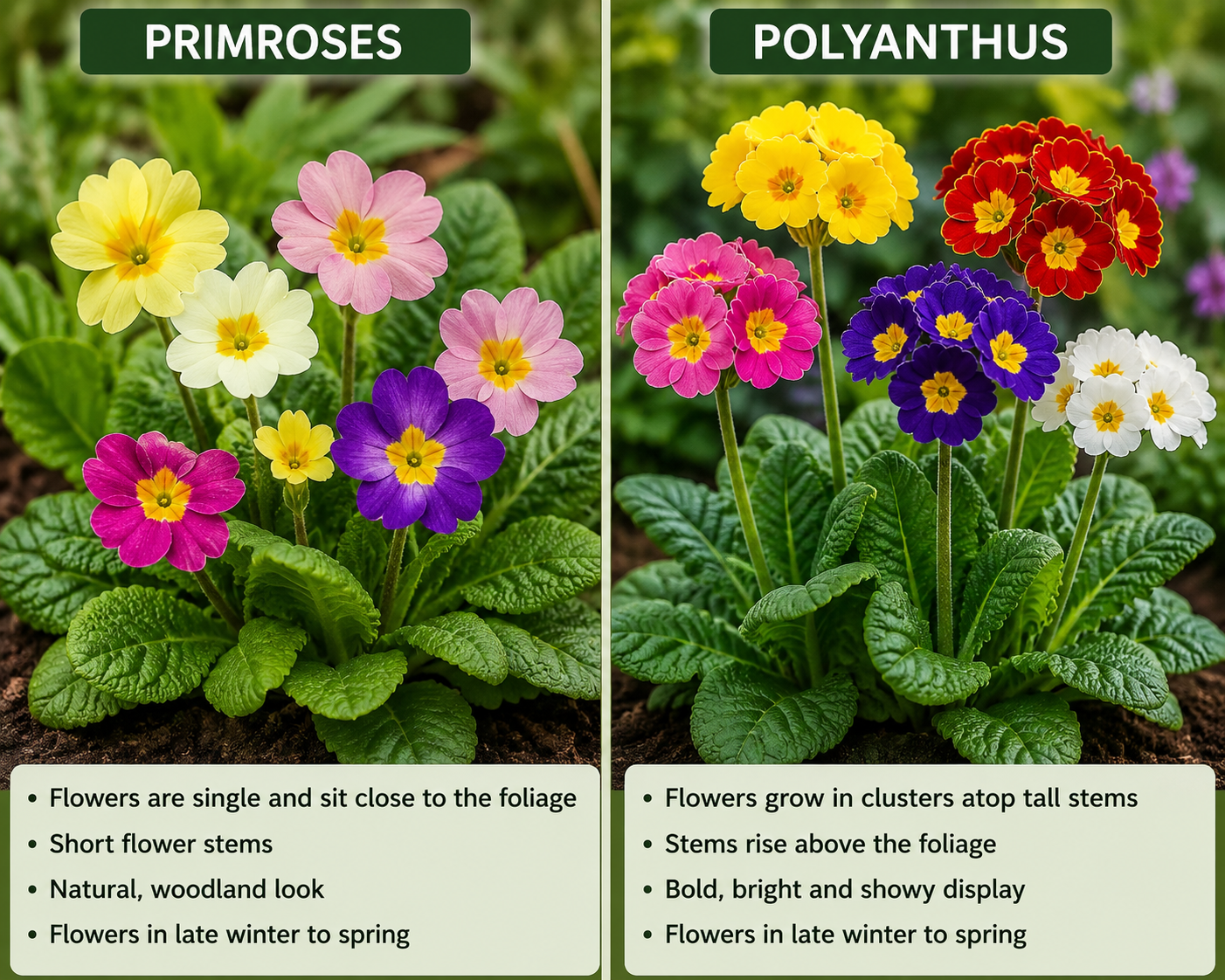
Primroses (Primula vulgaris) are charming perennial plants that produce individual flowers on short stems close to the foliage. Their blooms appear to emerge directly from the centre of the leafy rosette, creating a natural woodland appearance.
Primroses are available in a wide range of colours, including yellow, pink, red, purple, blue and white. They are particularly well suited to cottage gardens, woodland settings, shaded borders and naturalised planting schemes.
Diagram 1: Typical Primrose Flower Structure
       Flower
         🌸
          |
          |
     [Leaves]
   🍃🍃🍃🍃🍃
Single flower held close to the foliage.
What Are Polyanthus?
Polyanthus (Primula × polyantha) are hybrids derived from several primrose species. Unlike primroses, they produce clusters of flowers on taller stems that rise above the leaves.
The flower heads contain multiple blooms grouped together, creating a much more colourful and eye-catching display. Polyanthus flowers are often larger than those of primroses and are available in a vast range of vibrant colours and bicolour combinations.
Because of their bold appearance, polyanthus are widely used in bedding displays, patio containers, borders and public planting schemes.
Diagram 2: Typical Polyanthus Flower Structure
    🌸 🌸 🌸
      🌸 🌸
         |
         |
         |
     [Leaves]
   🍃🍃🍃🍃🍃
Clusters of flowers held above the foliage on taller stems.
Key Differences Between Primrose and Polyanthus
| Feature | Primrose | Polyanthus |
|---|---|---|
| Flower Arrangement | Single flowers | Flower clusters |
| Stem Height | Short stems | Taller stems |
| Appearance | Natural and delicate | Bold and colourful |
| Best Garden Style | Woodland and cottage gardens | Bedding displays and containers |
| Flower Size | Generally smaller | Usually larger |
| Impact | Subtle and natural | Bright and dramatic |
Diagram 3: Side-by-Side Comparison
PRIMROSE                POLYANTHUS

     🌸                🌸 🌸 🌸
      |                  🌸 🌸
  🍃🍃🍃🍃🍃              |
                         |
                     🍃🍃🍃🍃🍃

Single Flower      Cluster of Flowers
Low Growing        Raised Flower Stems
Growing Conditions
Fortunately, both plants enjoy very similar growing conditions. They thrive in moist, fertile, well-drained soil and prefer a position in partial shade, although they can tolerate some morning sunshine.
Both flower from late winter through to spring and are excellent sources of early-season colour when few other plants are in bloom. Regular watering during dry periods and the removal of faded flowers will help prolong the display.
Which Should You Choose?
If you prefer a natural woodland look with delicate flowers nestled amongst the foliage, primroses are an excellent choice. However, if you want a brighter, more dramatic display that stands out in borders, containers or bedding schemes, polyanthus may be the better option.
Many gardeners choose to grow both together, combining the subtle charm of primroses with the vibrant impact of polyanthus to create a long-lasting and colourful spring display.